

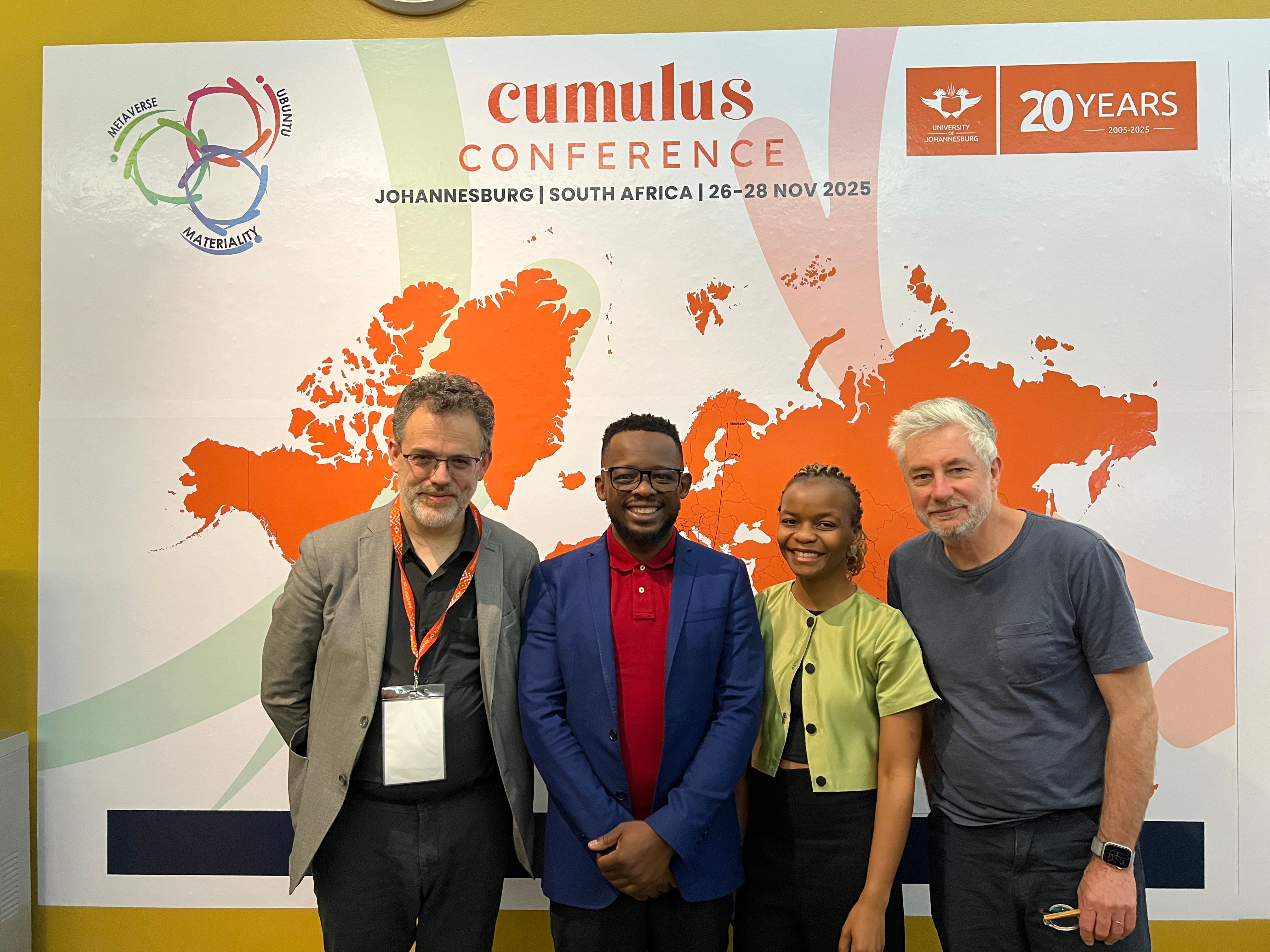
This question has been following me around for a while, but it became very real at the recent Cumulus Conference at the University of Johannesburg (UJ). I joined a panel facilitated by Frédéric Degouzon (Director of International Strategy & Development at L’École de design Nantes Atlantique), alongside Pierre-Yves Panis (Chief Design Officer at Signify) and my friend and colleague, Kgothatso (KG) Lephoko, a senior lecturer at UJ and PhD candidate in Digital Transformation at the Johannesburg Business School.
In the intimate audience were practitioners and educators from South Africa and around the world. People weren’t there for abstract theory. They wanted to know what this actually means for their work, their students, and their careers.
This article is my attempt to slow that conversation down and make sense of a few threads:
The reality check: What is genuinely new, and what is just another tool shift.
The talent impact: How this hits juniors, mid-levels, and seniors differently.
The African context: Why our “missing data” is both a risk and a strategic opportunity.
The human moat: Why our most important work now is to amplify what makes us human, not imitate machines.
What’s new, and what isn’t
Let’s start with a simple truth: concern is real, but it isn’t new.
We’ve been through disruptive tool shifts before. Many of us remember the transition from paper to tools like Freehand, to Adobe Creative Suite, and now to Figma and Miro. Each wave automated something that used to be slow, manual, and sacred to the craft.
Despite each wave, design didn’t vanish. What kept the profession relevant was not the tool, but the underlying principles: empathy, systems thinking, and a clear view of consequences.
However, AI is different in two specific ways:
Speed: It doesn’t just accelerate execution; it collapses the time between “thought” and “artefact” to near zero.
Mimicry: It generates layouts, copy, and code that look deceptively “human” at first glance.
This creates a new tension. The barrier to entry for producing design has lowered, but the barrier to entry for valuable design, work that solves real business problems without introducing risk has risen.
Who is actually at risk? (The squeeze has moved)
When I first started tracking the rise of Generative AI, my immediate worry was for the juniors. I looked at the automation of basic tasks and wondered: if the bottom rung of the ladder is gone, how does anyone start climbing?
But the more I observe teams adopting these tools, the more my perspective has shifted. I am less worried about the new entrants, and significantly more concerned about the middle layer.
Here is how I see the risk and opportunity distributing across the three tiers of our industry:
1. Juniors: The disappearing “grunt work”
Traditionally, juniors cut their teeth on low-risk, repetitive tasks: resizing assets, cleaning wireframes and churning out screens. AI now handles this execution instantly.
The Risk: If the “grunt work” disappears, where do juniors learn the craft? How do they develop the intuition that comes from doing the work manually 100 times?
The Opportunity: Juniors are effectively AI-natives. They have less ego tied to “how we used to do it” and are willing to experiment rapidly. If we structure their roles correctly, they stop being “production assistants” and become rapid prototypers who can stress-test ideas faster than any senior team could.
2. Seniors: Context as a moat
Senior practitioners carry something AI does not have: deep institutional memory and political context. They know why the last product failed, they understand regulatory constraints, and they can read the room during a difficult stakeholder meeting.
The Risk: Complacency. If seniors refuse to engage with the tools, they become expensive bottlenecks.
The Opportunity: They become the “orchestrators.” They use AI to generate options, while they focus entirely on problem framing, ethics, trade-offs, and decision-making.
3. Mid-levels: The squeezed middle
This is the group I now worry about most. They have more responsibility than juniors but less strategic leverage than seniors. Their value has often been defined by being “very good executors”, the safe pair of hands that delivers high-quality assets.
The Risk: AI is moving hardest into the execution layer. Being a “good executor” is no longer a defensible position when a machine can execute faster and cheaper.
The Opportunity: They must move up the stack into problem definition and facilitation. They need to stop protecting the pixels and start bridging the gap between business goals and AI-assisted delivery.
The “Power Pair” Hypothesis This creates a fascinating new dynamic. I believe we might see the emergence of a “barbell” team structure where the combination of Junior + Senior becomes the most powerful unit in the business.
Imagine a fearless, AI-native junior who can prompt, iterate, and generate at high velocity, paired directly with a seasoned senior who provides the taste, the constraints, and the strategic direction. The junior provides the speed; the senior provides the compass. Together, they can move faster than a traditional heavy team structure, bypassing the “review loops” of the middle layer entirely. The middle must evolve to facilitate this system, or risk being bypassed by it.
What I’ve learnt about how AI actually works
Through my learnings at IMD and from experts like Dr Jay van Zyl, my mental model for AI has shifted from “magic” to “mechanics.”
It is a pattern machine, not a thinking partner. AI predicts the next pixel or token based on data. It does not have lived experience, a body, or a stake in the outcome. It doesn’t lie awake at night worrying about whether a design decision will pose a reputational risk to the bank.
In Johannesburg, I framed it this way:
“Don’t ask AI for the meaning of life. Tell it the meaning of life – then interrogate it based on your input.”
This shifts the workload from creation to curation.
If you ask AI to “fill in the gaps,” you are outsourcing thinking (high risk).
If you feed it your context, constraints, and principles, and then critique the output, you are using it as an amplifier (high value).
The limits of compute There isn’t enough computing power in the world to replace the context and complexity of a room full of humans. AI creates connections at scale, but it operates in a bounded reality. It creates outputs; humans own outcomes.
Africa is not a footnote – it’s the missing data
If you are working in South Africa or emerging markets, you know that most Large Language Models (LLMs) are trained on Global North data.
This means our languages, financial realities, informal economies, and regulatory nuances are often treated as edge cases or missed entirely.
The Risk: We deploy tools that make confident but harmful recommendations because they don’t understand the context of a user in Soweto or a small business in Nairobi.
The Opportunity: We don’t have to accept being an afterthought. There is massive strategic value in:
Curating local datasets: Building the proprietary data that makes AI actually work for our markets.
Designing for constraints: We are experts in designing for low bandwidth, high data costs, and diverse languages.
Governance: We can lead the way in designing evaluation criteria that catch local harms early.
We are not just consumers of this technology; we have the opportunity to shape how it is adapted.
The Human “Unfair Advantage”
If AI handles the patterns, what is left for us?
1. Embodied Empathy AI can mimic the language of empathy, but it feels nothing. Designers see the hesitation in a client’s eyes, the tension in a user interview, the silence in a boardroom. We use that unspoken data to make decisions.
2. Sense-making in messy systems Organisations are political and emotional. A model might suggest an “optimal” process that is mathematically perfect but culturally impossible. Humans navigate the gap between “optimal” and “real.”
3. Holding Tension Leadership is often about holding contradictory truths: innovation vs. stability, efficiency vs. humanity. AI optimises for a single objective function. Humans can hold the tension between competing values.
A pragmatic path forward
We need to move from “talking about AI” to changing how we practice. Here is where I believe we should focus:
For Practice: Redesign the apprenticeship
Stop hiding the tools: Treat AI literacy like typography, a core craft skill.
Pairing: Pair AI-native juniors with context-rich seniors. Let the junior drive the tool; let the senior drive the critique.
Focus on metrics: Don’t measure “AI adoption.” Measure whether it’s helping us learn faster, reduce rework, or deliver better client outcomes.
For Research: Interrogate the model
Question the source: “Whose data is this trained on?” “Where does this break for our users?”
Real-world loops: Don’t rely on synthetic data. Build feedback loops from real client behaviour in our specific markets.
For Education: Assess the thinking, not the artefact
Shift the grade: If AI can produce a polished UI in seconds, the grade shouldn’t be for the UI. It should be for the problem framing, the ethical reasoning, and the justification of the solution.
Context is king: Encourage projects rooted in African realities, where “out of the box” AI solutions fail and human ingenuity is required.
Optimism with eyes open
My stance is simple: AI will absolutely change how we work. It will reshape career paths and expose gaps in our systems.
But it does not remove the need for thoughtful, principled leadership. If anything, it raises the bar. The challenge for us in Africa is to ensure we are not passive test subjects for other people’s algorithms. We have the talent and the lived experience to co-author this story.
The real question isn’t “Will AI replace us?” It is: “Will we use this moment to amplify what makes us uniquely human or quietly outsource it?”
Call to Action
I am partnering with two industry peers to co-author a deeper dive into this topic.
If you are working at the intersection of design, AI, and business strategy, specifically in the African context and want to share your experiments or challenge these ideas, I’d love to hear from you.
Let’s write the story ourselves.