

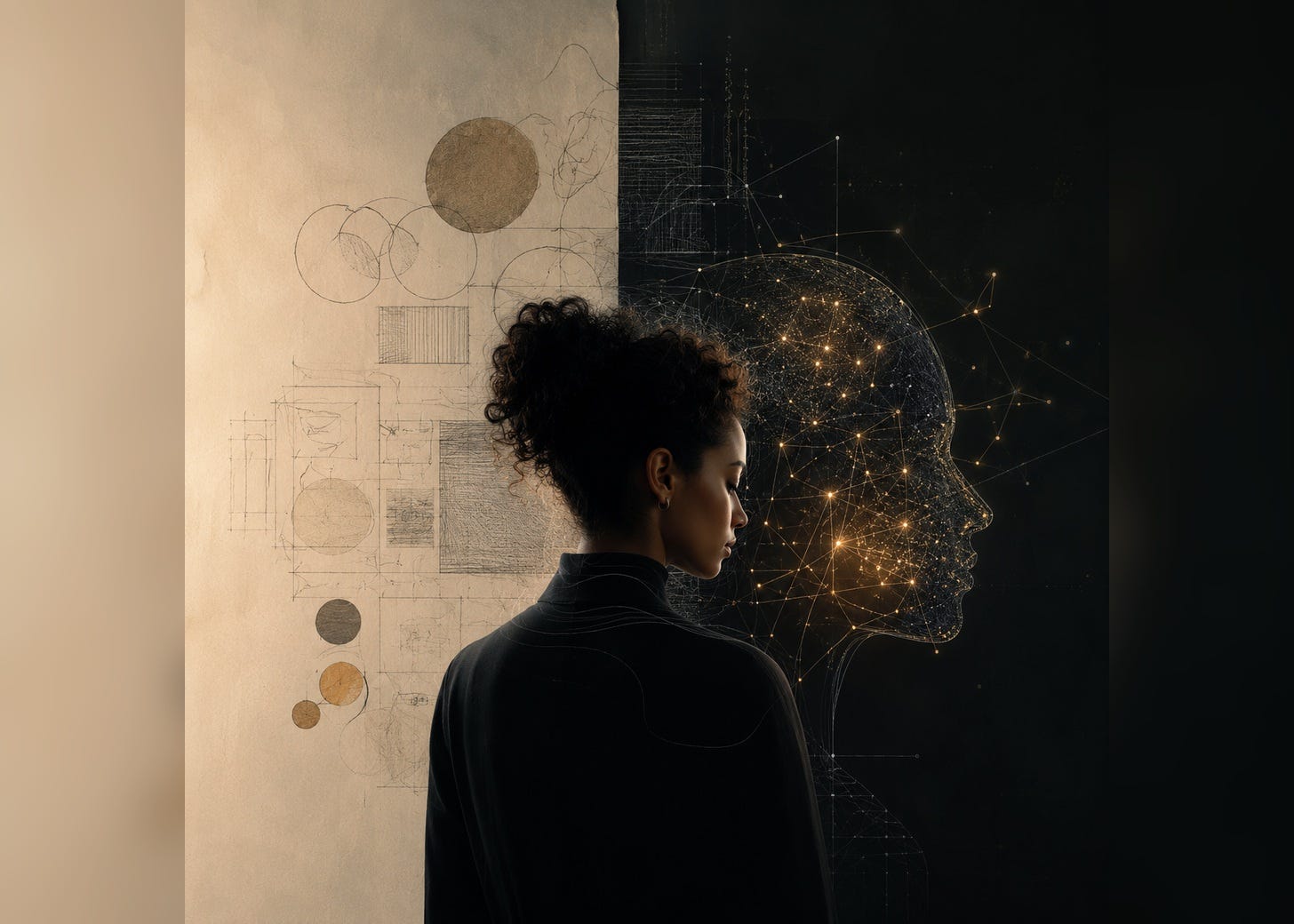
With AI advancing at breakneck speed, the question of replaceability has taken on a sharper edge. Tools aren’t just supporting our work anymore, they’re doing it. Which raises the debate worth having: in the product–design–tech triad, are these roles in danger?
At the task level, the answer is yes. AI is dismantling traditional disciplines at speed. Product managers who spend their time grooming backlogs or compiling reports are already being edged out by smarter tools. Designers who once poured hours into wireframes and UI explorations are watching generative platforms create them in seconds. Engineers writing boilerplate code are being matched, and often outpaced, by copilots that can generate, test, and refactor faster than any human. If your value sits in repetitive, tactical execution, then you are replaceable.
But the story changes at the higher levels. Senior product managers who can craft a vision and build executive alignment still matter. Architects who design for resilience in messy, regulated environments are indispensable. And designers who can connect the dots between customer journeys, business systems, and organisational outcomes are not just safe, they’re poised to lead.
While all three disciplines require creativity, their center of gravity differs. For product managers, it often sits in logic, prioritisation, and feasibility. For engineers, it lies in precision, scale, and resilience. Design’s unique power is that its center of gravity rests in human ambiguity and intuition. We are trained to begin in the chaos of human needs and create coherence from it.
Apple’s obsession with typography and Airbnb’s reinvention of trust are familiar examples, but we need to bring this lens to today’s AI-driven world. Imagine two AI-powered financial planning tools. The tech-and-product-led version might perfectly optimise a user’s portfolio based on data. It’s efficient but cold. The design-led version first seeks to understand the user’s relationship with money, their fears, hopes, and dreams. The resulting AI doesn’t just give advice; it builds trust, educates with empathy, and frames its suggestions in a way that aligns with the user’s life goals. One manages a portfolio; the other empowers a person. That is the difference design makes.
AI makes this adaptability even more critical. Yes, the tools are automating traditional design tasks, but that only frees us to focus on what machines cannot replicate: creativity and intuition. AI is exceptional at processing what already exists. Designers, however, can imagine what has never existed. We can intuit the leap from “what is” to “what could be.” That human spark,the ability to create the unexpected is where our edge lies.
This is why unplugging matters. If all we do is lean on AI, we’ll end up regurgitating the same recycled outputs the machine feeds on. The real value comes when designers step back, breathe, and listen to what humans need, not just what the dataset suggests. Once we’ve made that leap, then we can bring AI back into the process as a multiplier, not a master. Those who don’t will drown in sameness. Those who do will shape the future.
I see design as the most human operating system for business. AI can generate, but it cannot care. It can simulate choice, but it doesn’t understand consequence. It can remix fragments, but it cannot weave them into trusted, coherent experiences. That’s our job, and it has never been more important than it is now.
The Designer’s Leadership Playbook for the AI Wave
If design is to lead in the AI era, we must lean into the traits that set us apart.
1. Championing the Human Experience
Product and tech often begin with feasibility and optimisation. Designers start with people. We ask not only can we build it or should we build it, but does it truly solve a human problem? In an AI-driven world, this instinct to anchor in the human experience is a leadership trait.
2. Connecting Strategy to Execution
Designers excel at taking a big idea and translating it into practical, testable steps without losing sight of the bigger picture. It’s this ability to make vision tangible that keeps execution tethered to strategy in the middle of chaos.
3. Integrating Across Silos
Design is a natural integrator. We sit between business, technology, and customer needs, and we speak the language of all three. While PMs optimise for delivery and developers for efficiency, designers hold the wider view and ensure coherence across silos.
4. Creating the New Through Intuition
AI can only remix what’s already there. Designers can create something truly new. We combine data with intuition, cultural understanding, and creativity to make leaps into the unexpected. This is the space where real differentiation happens.
5. Crafting the Narrative of “Why”
Design doesn’t just produce solutions, it frames them. We tell stories that help people see, feel, and believe in a future. In a world flooded with AI-generated outputs, the ability to articulate why it matters is what inspires action.
So here’s the rallying call: design doesn’t just have a chance to survive this wave, it has the responsibility to lead it. AI is changing what work looks like for all of us, but design is the discipline best placed to rise above the noise. If we lean into our humanity, our creativity, our integrative instincts, and our storytelling, we can become the operating system that makes everything else work.
The real question isn’t who’s most replaceable. The real question is who’s most ready. And in the age of AI, it has never been more important to be a designer.